


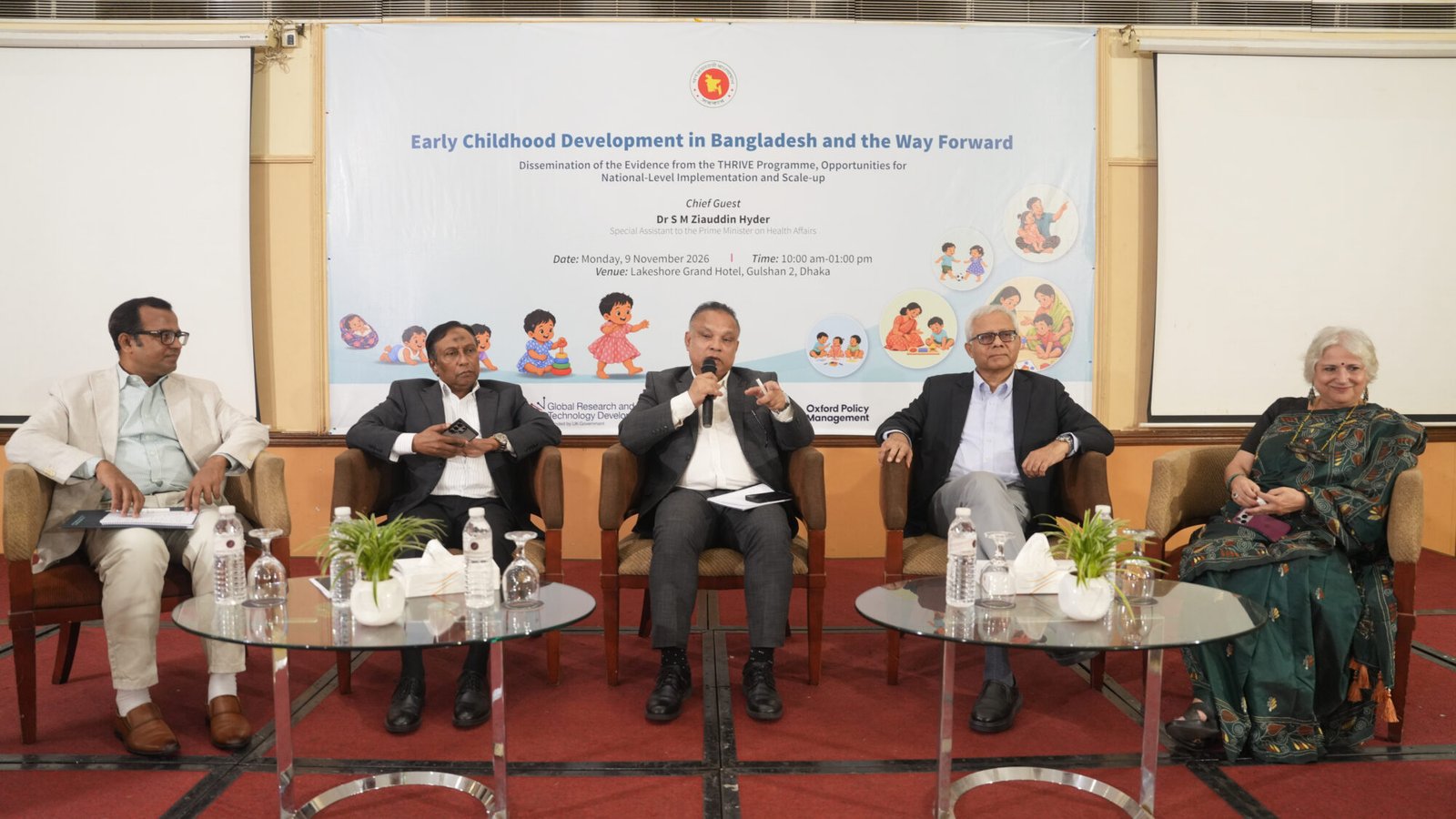
Bangladesh can advance early childhood development by utilizing its current state healthcare network, though scaling up services alone will not guarantee success. Maintaining standards, enhancing frontline worker capabilities, providing consistent oversight and securing sustainable financing are vital components. These insights were highlighted during a study presentation on Monday, November 9, at a national research dissemination event in Dhaka titled “Early Childhood Development in Bangladesh: The Way Forward.” Policymakers, researchers and development partners gathered as Dr. Jenna Derakhshani Hamadani, Emeritus Scientist at icddr,b and National Principal Investigator of the Thrive programme, shared the findings.
The Strengthening Bangladeshi Babies’ Brains programme extended early childhood development initiatives to over 600 community clinics nationwide, serving more than 15,000 children. The initiative trained approximately 1,950 frontline health personnel and over 400 supervisors, resulting in better childcare habits, improved home learning environments and increased use of play items among participating families. Nevertheless, the evaluation noted no statistically significant variation in broad child development indicators. Experts pointed out that broader coverage must be paired with consistent execution, routine oversight and robust support for staff.
Addressing the gathering, icddr,b Executive Director Dr. Tahmeed Ahmed noted the strong connection between childhood nutrition and neurological growth. Early nutritional deficiencies can impair cognitive capacity, making it essential to prioritize both dietary health and mental stimulation. Dr. S. M. Ziauddin Haider, Special Assistant to the Prime Minister for Health Affairs, served as the chief guest and stated that the country now possesses ample empirical data regarding the value of early childhood interventions. He advocated for a comprehensive national strategy to overcome hurdles in children’s education and ensure nationwide access.
Mohammad Golam Kibria, Education Adviser and Team Leader at the UK Foreign, Commonwealth and Development Office, remarked that nationwide scaling demands preserving service standards, boosting staff expertise, guaranteeing long-term financial support and fostering state ownership. A. K. M. Fazlu Zzohha, Managing Director of the Community Clinic Health Support Trust, commended the efforts of icddr,b and underscored the value of leveraging current insights for future expansion. Future priorities identified at the conference include tighter monitoring, adequate staffing, continuous parental involvement, stable financing and official government stewardship.