


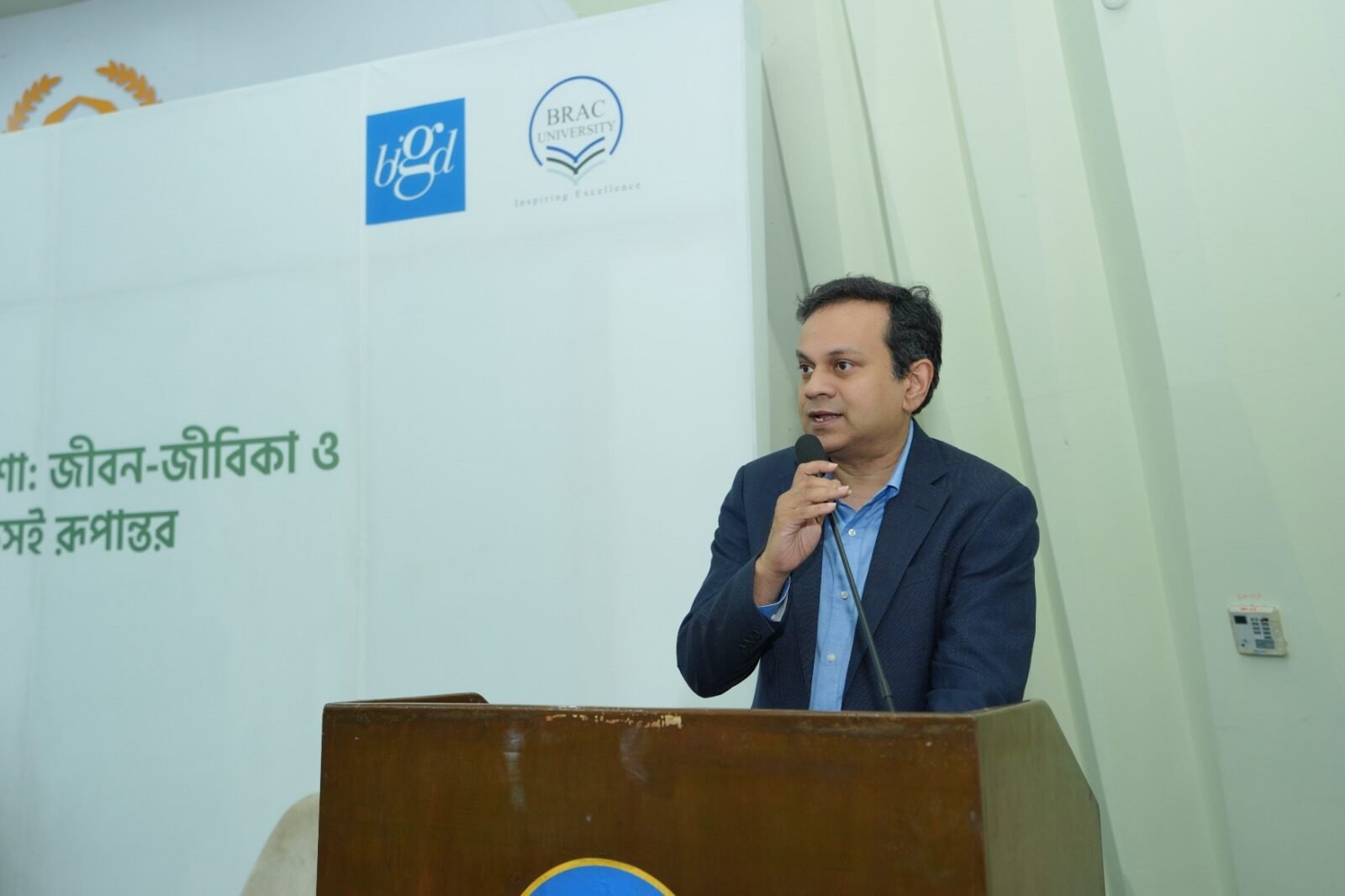
Experts and municipal officials have called for a multi-year phased plan to bring battery-powered rickshaws under formal regulation without destroying the livelihoods of hundreds of thousands of workers. The recommendations were presented on Tuesday, November 24, at a policy dialogue held at the CIRDAP Auditorium in Dhaka, based on joint research by BRAC and the BRAC Institute of Governance and Development (BIGD).
Speaking at the event, BRAC Executive Director Asif Saleh stated that policymakers frequently overlook the concerns of informal sector workers. He suggested that instead of imposing sudden bans or strict restrictions, authorities should implement a three-to-four-year transition strategy to gradually regulate the sector while safeguarding drivers, garage operators, mechanics, and their families.
The study underscored significant financial vulnerability among drivers, revealing that nearly 96 percent of surveyed battery-powered rickshaw operators lacked a licence or permit. Furthermore, roughly two-thirds of drivers reported experiencing fines or harassment, while 26.7 percent had been involved in at least one road accident in the month preceding the survey.
The research also pointed to major rural-to-urban migration patterns. Over 78 percent of battery rickshaw drivers in Dhaka had moved from other districts, with 84 percent of those migrants identifying a lack of rural employment as their primary reason for moving. Additionally, 78.2 percent of drivers rented their vehicles, spending an average of 38.6 percent of their income on rent. Due to low savings, 62.9 percent stated they could not support their families for even a week if their daily earnings ceased.
City corporation leadership highlighted the need for coordinated management. Md Abdus Salam, Administrator of Dhaka South City Corporation, noted that urban issues such as traffic congestion, air pollution, and waste management are closely linked and must be tackled together. Dhaka North City Corporation Administrator Md Safiqul Islam Khan Milton stated that authorities do not oppose auto-rickshaws, but bringing them into a legal framework is necessary to establish accountability and provide support.
The report also identified garages as vital hubs that pose risks due to unregulated electricity usage, public land encroachment, and informal lead-acid battery recycling. While the Local Government Division introduced the Three-wheeled Low-speed Battery-powered Rickshaw Operation Rules in 2026, implementation remains a challenge. The BRAC-BIGD study surveyed 450 active drivers across Dhaka and Barishal between June 11 and July 30, 2026.