


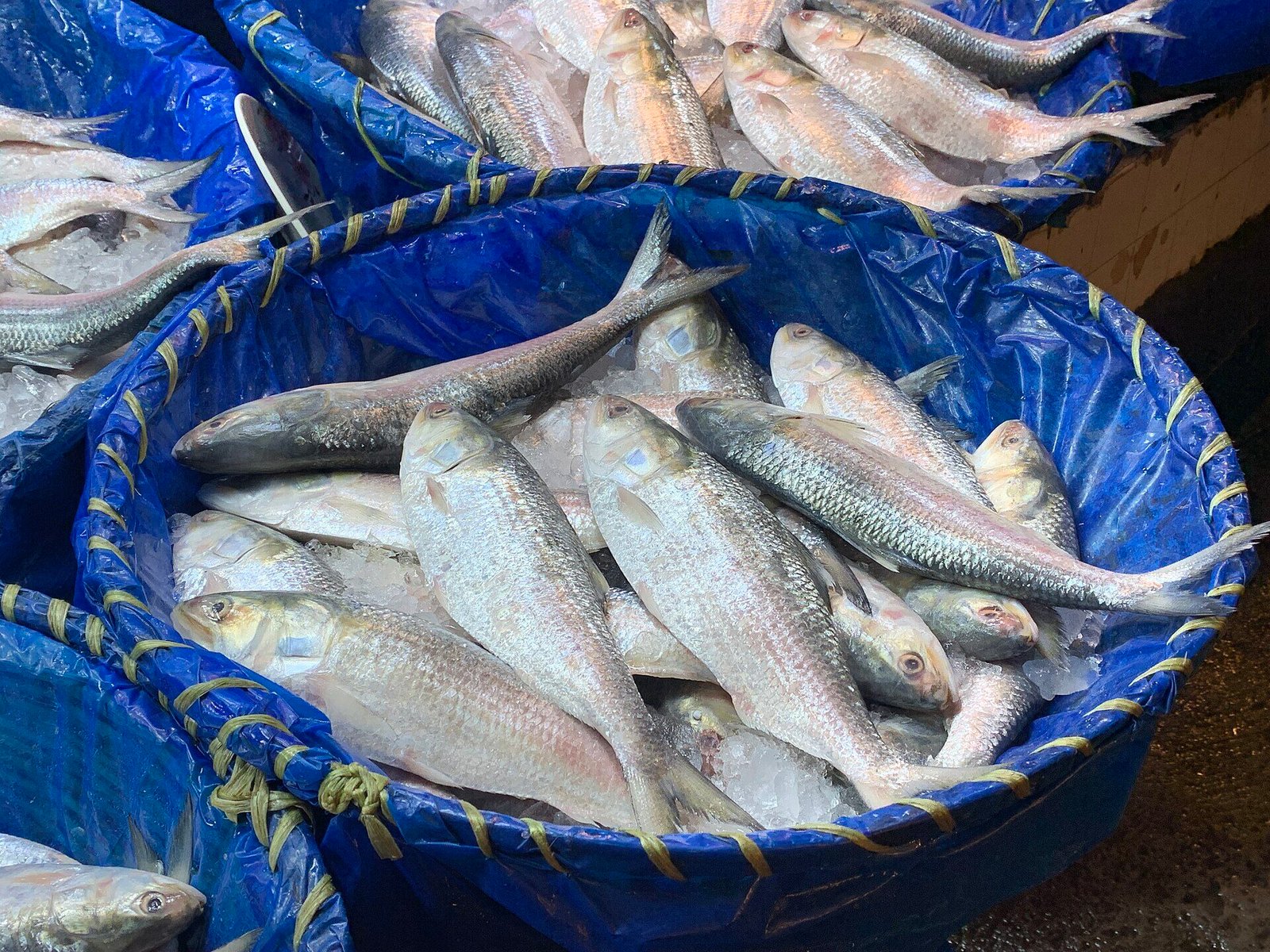
Bangladesh’s annual hilsa production fell by more than 12 percent across two consecutive fiscal years, driven by a sharp drop in marine catches and environmental degradation along key river migration routes. Official figures show a steady decline in total harvests despite an increasing number of fishing vessels operating in coastal waters.
Data from the Department of Fisheries reveals that total yield dropped from a record 571,342 tonnes in the 2022-23 fiscal year to 500,288 tonnes in the 2024-25 fiscal year. This represents a decrease of 71,054 tonnes, or roughly 12.4 percent, over the two-year period, following an intermediate output of 529,487 tonnes recorded in fiscal year 2023-24.
The contraction was most severe in sea catches, which plummeted by 22 percent over three years. Maritime hilsa harvests fell from approximately 322,000 tonnes in fiscal year 2021-22 to around 251,000 tonnes in 2024-25, taking nearly 71,000 tonnes of fish out of the ocean supply.
Acknowledging the lower figures, the Minister of Fisheries and Livestock stated that the government is aware of the nationwide reduction in hilsa yields. Coastal fishing communities report growing financial hardship as a result of the shrinking catch.
In Mohipur under Patuakhali district, the fleet of seafaring fishing boats expanded from about 800 vessels seven to eight years ago to nearly 1,500 today. Despite this significant rise in fishing effort, total output has failed to grow, leaving many fishermen struggling to cover basic operational expenses for each sea trip.
Scientific experts point to severe ecological challenges in river channels. Hilsa researcher and former Fisheries Research Institute director Anisur Rahman noted that the availability of large-sized fish has diminished, while reduced water depth along routes connecting the sea to main rivers is obstructing migration.
Recent surveys show that dry-season salinity in the Meghna estuary has reached nearly 10 parts per thousand, almost double the concentration recorded ten years ago. Declining freshwater inflow from upriver increases salt levels, adversely impacting hilsa breeding and natural movement patterns.
Hilsa accounts for roughly 12 percent of Bangladesh’s total fish production and serves as a major source of income for coastal and riverbank populations. Although some estimates for the 2024-25 fiscal year vary slightly—citing figures such as 512,000 or 504,000 tonnes—the overall data reflects a clear downward trend.